Is AI Safe for Personal Training? How Coach-Approved AI Plans Work
Is AI safe for personal training? See how guardrails, coach approval and plain-language explanations keep AI-built workout and diet plans under a coach's control.
AI can be safe for personal training when it works inside limits and a qualified coach approves whatever reaches the client. It is not safe as an unsupervised replacement for a coach: it cannot examine a client, judge technique or assess an injury. The safe pattern has three parts: bounded changes, human approval and visible reasoning. That is how Trainzilla's AI Coach is built.
What can go wrong with unsupervised AI workout plans?
- Plausible-sounding but inappropriate exercise choices for a given client.
- Large jumps in volume, intensity or calories from one week to the next.
- No awareness of injuries, medical context or a client's real life.
- No explanation, so the client cannot tell why something changed and quietly stops trusting it.
What are guardrails on AI plan changes?
Guardrails are limits on how far the AI is allowed to move a plan in one step. In Trainzilla, volume, intensity and calorie swings are bounded, so a single proposal cannot make a wild jump. Guardrails reduce avoidable programming errors. They do not diagnose an injury or replace a coach's judgement, and they are not meant to.
What does "coach in the loop" actually mean?
It means the AI drafts and the coach decides. The AI reads the client's profile, logs, habit compliance and recent check-ins, then proposes a change. The coach previews it and approves it with one tap. Only then does it appear in the client's app. Nothing reaches a client on the AI's say-so alone, and the coach can reject or edit any proposal.
Why does explainability matter for safety and retention?
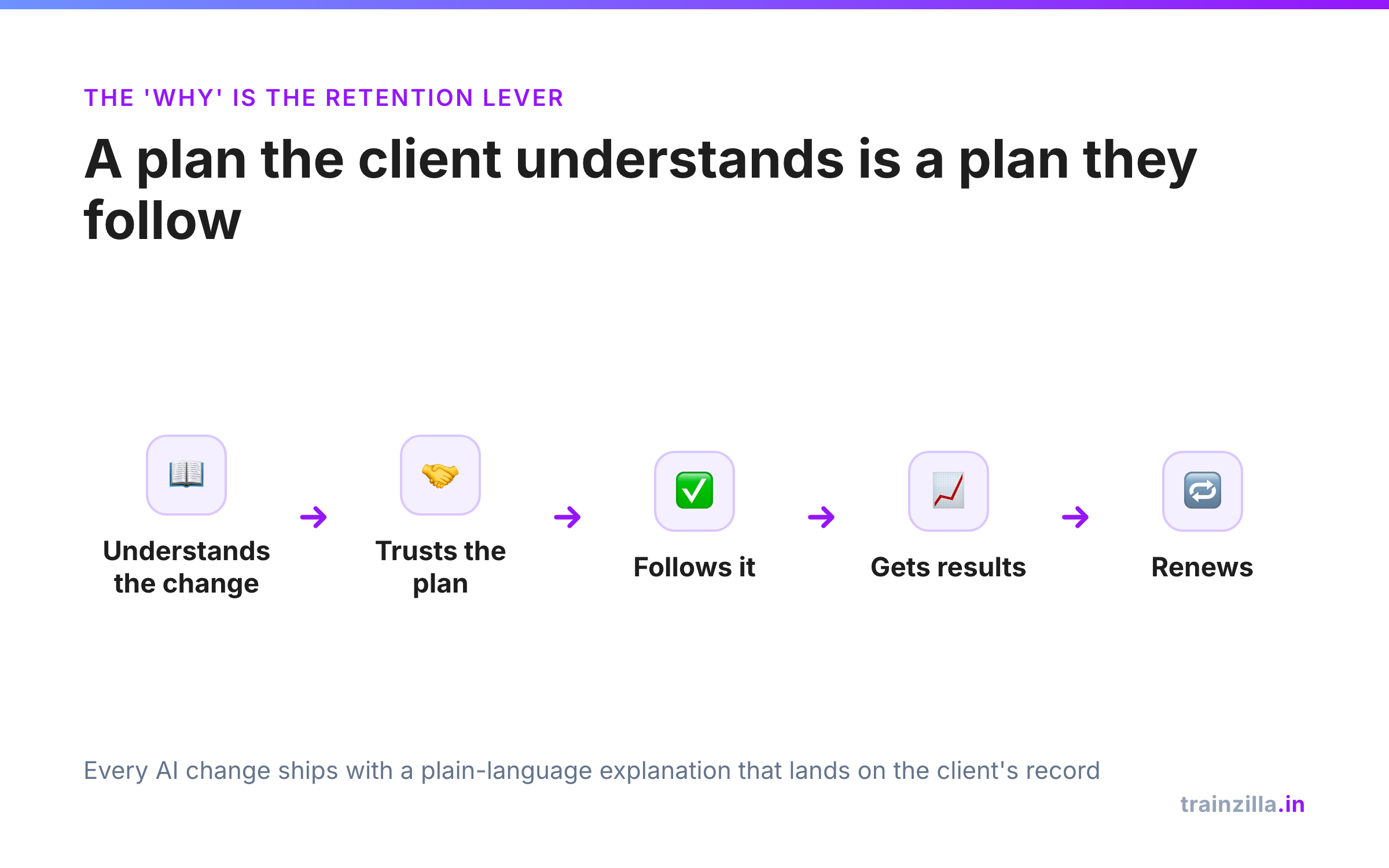
Every change the AI proposes comes with a plain-language "why this changed" note: what it looked at, what it adjusted and the numbers behind it. For the coach, that makes a proposal quick to sanity-check. For the client, it turns a surprising change into an understood one. We cover the client side in what AI coaching actually feels like for the client.
| Question | Fully automated AI plan | Coach-approved AI (Trainzilla) |
|---|---|---|
| Who signs off on a change? | Nobody; the algorithm decides | The coach, with one-tap approval |
| How big can one change be? | Often unbounded | Volume, intensity and calorie swings are bounded |
| Does the client know why it changed? | Rarely | Yes, a plain-language reason on every change |
| Who is accountable? | Unclear | The coach, who stays in charge of the client |
Fully automated AI plans versus coach-approved AI plans
What does the AI Coach actually look at?
It is not a chatbot. The AI Coach rewrites plans weekly from real data: check-ins, workout and diet tracking, habit compliance and recovery signals such as sleep. A bad-sleep week can dial a plan back before the client asks, still inside the guardrails and still waiting for approval.
What is AI still bad at?
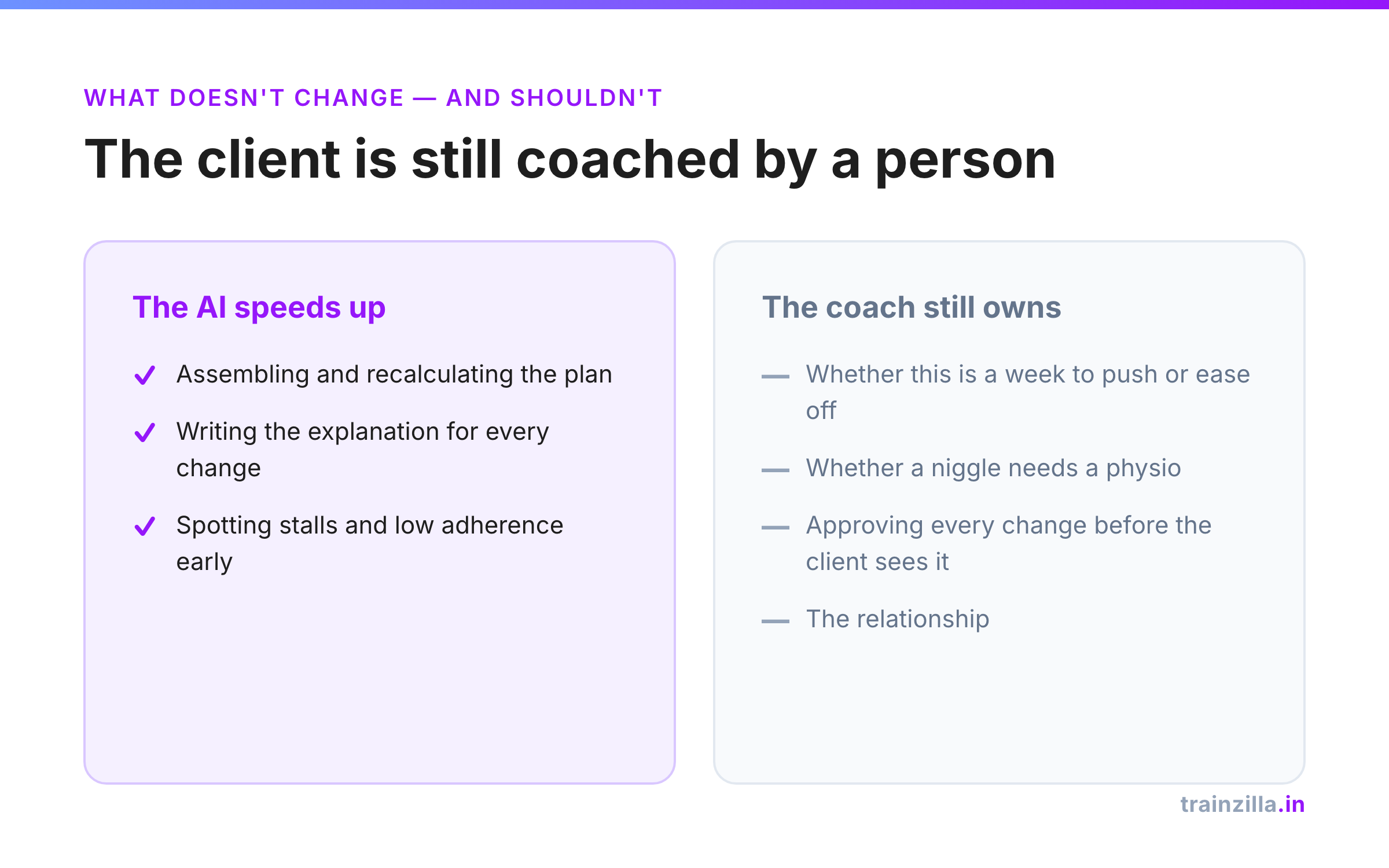
- Examining a client's movement or correcting technique.
- Judging whether pain is normal soreness or an injury.
- Knowing whether this is a week to push or a week to ease off for reasons that never appear in the data.
Those stay with the coach. The design goal is to remove the assembling-and-recalculating work, not the coaching. For coaches who want AI inside their own tools too, see AI agents for coaches.
Is the cost of AI actions transparent?
AI actions are metered in credits, so a coach can see what each action costs rather than discovering it on an invoice. Current plans and allowances are on the pricing page.
Frequently asked questions
Can AI replace a personal trainer?
No. AI can draft and adjust plans quickly, but it cannot assess technique, injuries or motivation. The strongest setup pairs a coach with AI that does the recalculating.
Is an AI workout plan safe for beginners or people with injuries?
Beginners and anyone with an injury or medical condition should have a qualified professional review the plan. That review is exactly what coach approval provides.
Does the client see AI changes before the coach approves them?
No. Proposed changes wait for the coach's approval and only then appear in the client's app.
How does the AI decide what to change?
It reads the client's profile, logs, habit compliance, check-ins and recovery signals, proposes a bounded change and writes down why.
Try coach-approved AI on one client
Start free, let the AI draft a change for a client, and approve, edit or reject it yourself.
Start freeGet the weekly coaching playbook
Keyword research, product tips and growth tactics for coaches — one email a week. No spam.
Dr. Priya Sharma
AI Researcher & Fitness Technology Expert with 12 years of experience in health tech innovation.
Start free — no card required
Set up your coaching business on TrainZilla in minutes. Free for 30 days, then upgrade to Coach Pro when you grow.
Related Articles
What AI coaching actually feels like for the client — and why that changes retention
"AI coaching" usually means the coach's workflow. But the client feels it too — in how fast their plan responds, and whether they understand why it changed. That second part is most of retention.
AI agents for coaches: what changes when the AI can actually see your clients
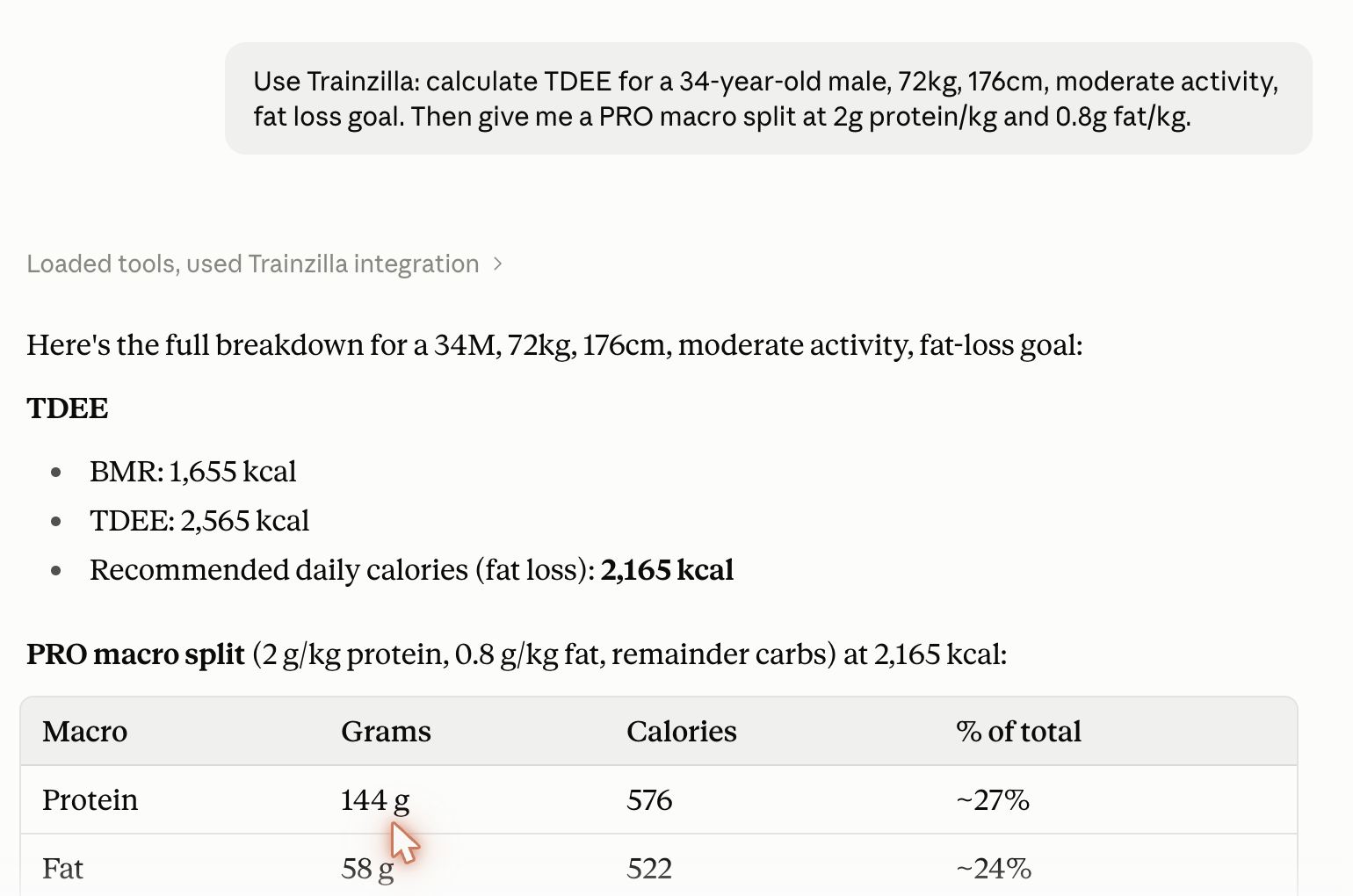
Most AI for fitness is a chatbot that has never met your clients. Here is what changes when your assistant can read your real Trainzilla account, and what we deliberately stopped it from doing.

The Future of Personal Training: The AI Revolution
How AI is transforming the fitness industry — from workout generation to progress prediction — and why the trainers adopting it now are pulling ahead.